
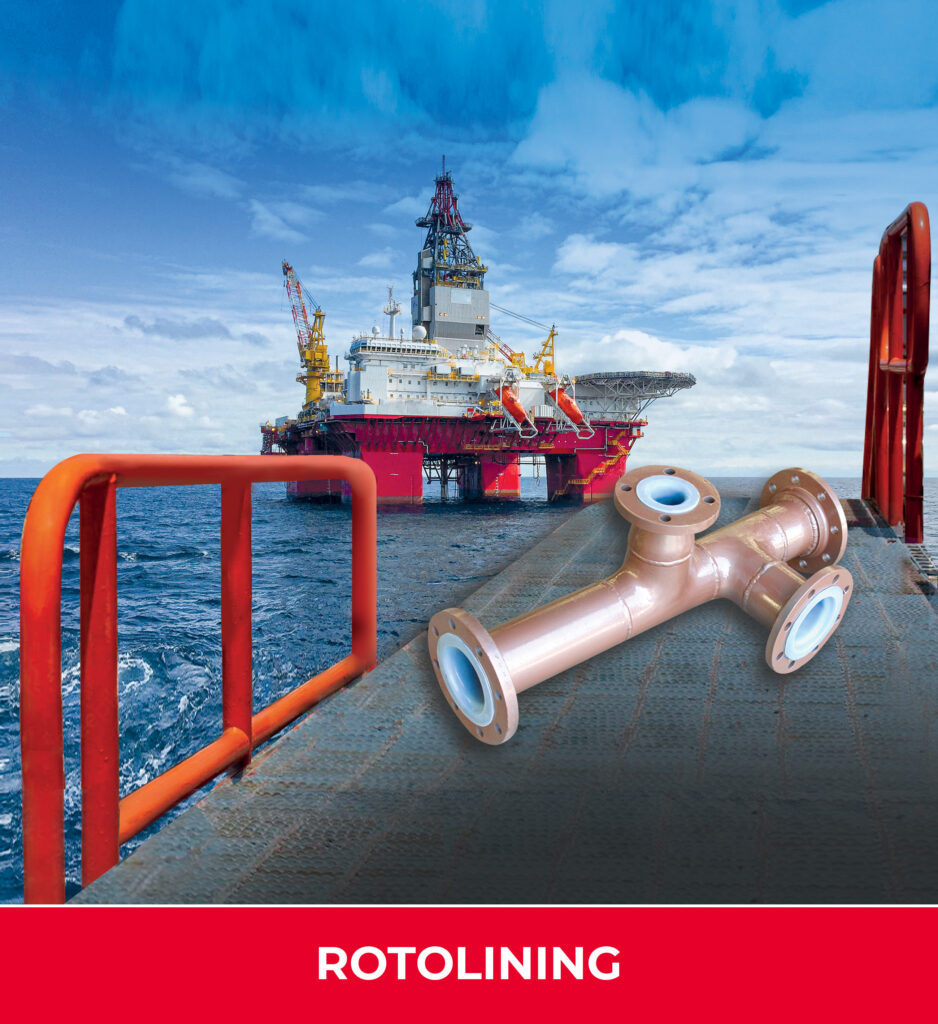
Also called rotational lining, rotolining technology involves bonding polymers to the interiors of tanks, pipes, or vessels, as well as to other materials used in a process. With rotolining, the resulting polymer layer provides resistance to chemicals and protects interiors from corrosion.
The process
A rotational process is carried out in which granulated and powdered resin is placed inside the vessel or equipment to seal all its openings and gaps. The vessel is then mounted in an oven, which rotates on perpendicular axes at low rpms, causing the resin to spread uniformly across the surface, moulding itself to the vessel’s shape and giving it enough time to melt. To prevent warping and shrinkage, the treated material is slowly cooled to reveal a seamless, permanently bonded lining. The thickness of the rotolining can range from 2mm to 16mm. This is thicker than most other lining alternatives. However, this depends on the equipment’s application and the polymer used.
Difference between rotolining and rotational moulding
While rotolining uses the actual equipment as the starting point rather than the mould itself, rotational moulding determines the resin first. Both processes are similar: the powdered resin is heated and shaped into the vessel. But in rotational moulding, the resin is removed after cooling, and a hollow is formed from the material.
Why Polycon’s rotolining?
Rotolining comes with multiple benefits. For one, it forms a non-welded joint that closes any potential points of hazards or leakage. While the equipment’s structural integrity improves, the flanges are easier to seal, reducing the risk of overflow. Rotolining offers unparalleled applications across a wide range of equipment, which is seldom offered by any other. The lining is fully bonded and has the ability to eliminate any annular permeation space and even withstand a vacuum. You can operate it at optimal temperatures and across a range of metallic substrates.
Polymers used in Polycon’s rotolining solutions
Depending on the application, polymer linings are applied, and many of these achieve the required levels of chemical, abrasion and corrosion resistance. Polycon uses its rotolining solutions including PE, ETFE, PVDF etc. that inhibits the growth of organisms that can microbially influence corrosion. The selection of the polymer is ideal so as to maximise the life of the equipment and reduce costs incurred towards maintenance.
Polycon’s rotolining solutions are formulated with best-in-class corrosion-protection technology and designed to last for decades. It offers protection against highly corrosive fluids, including sewage, crude oil, seawater, nuclear wastewater and other chemicals. Polycon’s rotolining has demonstrated ZERO failures operating from cryogenic temperatures up to 150°C. You experience improved flow rates, lower heat dissipation and lower pump power consumption.